


It's the end of October, a Monday morning. Christmas inventory planning is still pending, and stock levels need to last through Black Friday. Normally, that means exporting data, building spreadsheets, checking formulas, for days on end. At Comwave (handtuch-welt.de), Monday mornings look different. There, Managing Director Christian Hähnel asks his AI agent "Elke" a single question in natural language: "How much should we order per SKU for Christmas, and where are stockouts or overstock at risk?" A few minutes later, a prioritized list of order quantities and reasoning is ready.
This is made possible by the Co-Analyst from minubo, the first data platform for AI analytics and automation in E-Commerce. The Co-Analyst is your personal AI sparring partner: it knows your business, speaks your language, and answers questions about your E-Commerce data in seconds, even the complex ones. E-Commerce analysis now happens in dialogue, in the minubo chat or in the LLM of your choice. What happens behind the scenes at Comwave, and how other retailers are already using the Co-Analyst, we'll show you below.
How Comwave plans Christmas inventory in 20 minutes
Four weeks of manual work for the inventory planning of 10,000 SKUs: that's how Christmas planning at Comwave used to look. Too many products, too many factors, too little time to really think through every single SKU. With the Co-Analyst, that has changed. Via MCP access (Model Context Protocol), Christian Hähnel lets his AI agent work directly on the minubo data foundation, combining historical order data with ERP stock levels and trend forecasts, and generating ready-to-use order templates for his ERP system. Four weeks become 20 minutes, and a rough estimate becomes an inventory plan that takes every single SKU into account.
What works for inventory planning can be applied just as well to other recurring analyses, for example reordering and pattern recognition across the assortment.
How SugarShape keeps an eye on reorders and anomalies
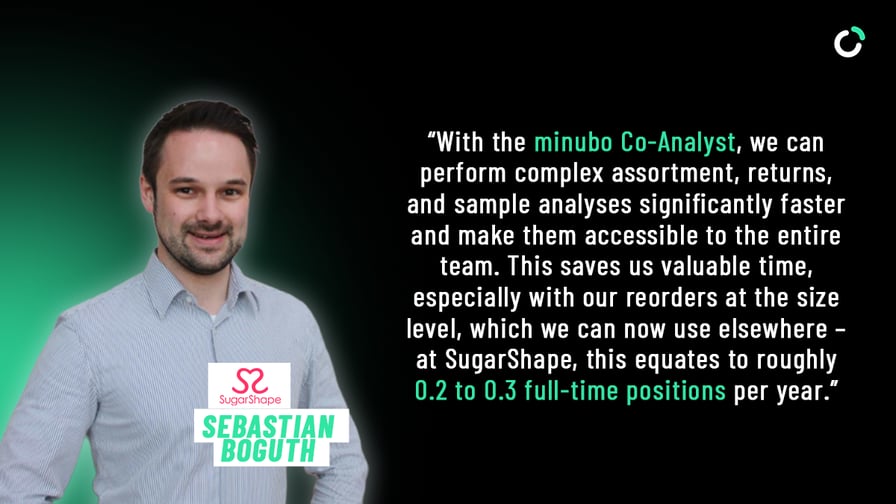
At SugarShape, a similar challenge comes with an added layer of complexity: products with up to 70 sizes and an assortment of 25,000 to 30,000 SKUs. Checking reorders by hand would take days, and anomalies at the supplier, category, or color level would easily go unnoticed. Sebastian Boguth (CFO, SugarShape) uses the Co-Analyst to prepare reorders at the size level and to test hypotheses about patterns and anomalies directly in dialogue. He describes the result like this:
Would you like to hear stories like the one from Christian and Sebastian in person? In our monthly Lunch & Learn customer sessions, they talk openly about their prompts, workflows, and learnings: Here you'll find all Lunch & Learn sessions
When analysis turns directly into action
Inventory planning and reordering are two examples of how the minubo Co-Analyst saves time. A third use case shows how an analysis becomes an automated decision. Imagine products with no contribution margin being automatically detected every week, analyzed for root causes, and delisted from your webshop. No exports, no spreadsheets, no manual digging. Sounds like magic? It's reality, and here's how it works: a weekly segmentation identifies all products with a negative contribution margin. The Co-Analyst then checks why, for example because of excessive discounts, and summarizes the findings in a decision template that's sent via an automation workflow (e.g., N8N) by email to the responsible person. Only after their approval are the affected products automatically deactivated in the webshop. The human decides, the AI proposes. The principle works with any platform that has an API, including marketplaces, marketing tools, or ERP systems.
(Note: You'll find a detailed article on this example here.)
What these examples have in common
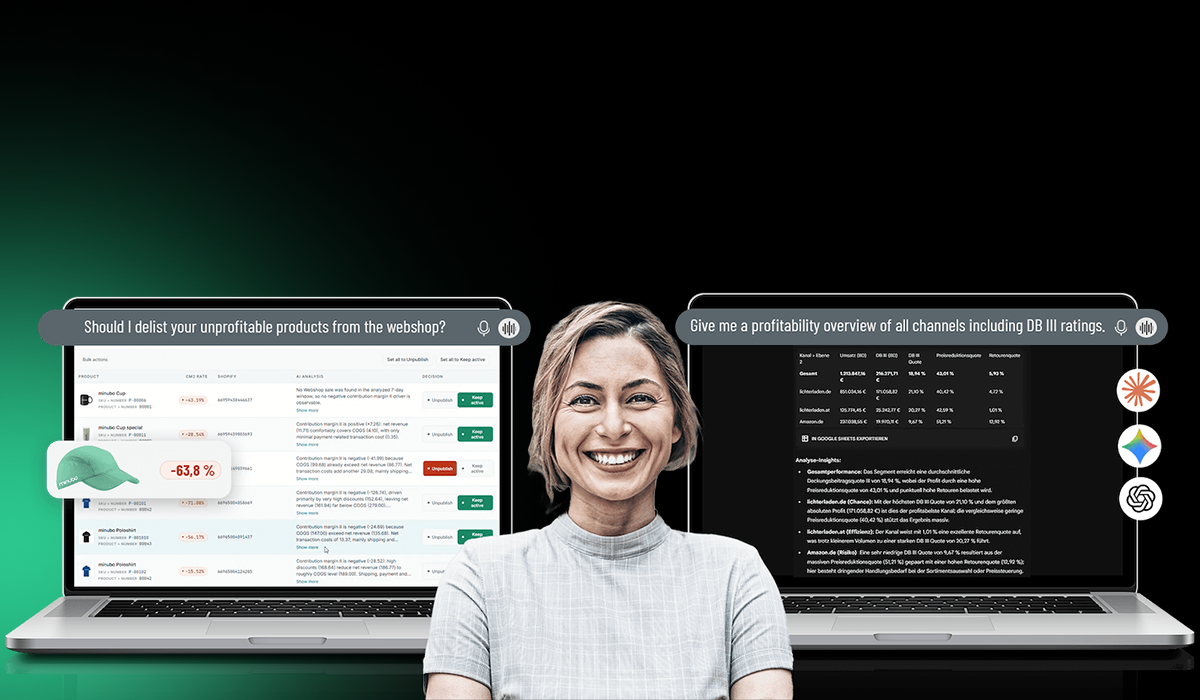
Whether it's inventory planning, reordering, or automated delisting: in all three cases, the minubo Co-Analyst takes on tasks that used to cost days or weeks, and delivers results your teams can rely on. In summary, this is what it means for your daily work:
- Extreme time savings: No more hours spent gathering data or waiting on the analytics team. Ask your question in a dialogue and make key decisions in seconds instead of days.
- Data power for everyone: Every department can work independently with data, no SQL or Excel skills required. Complex analyses become instantly understandable and usable for the whole team.
- AI analysis that stays transparent: Thanks to the proven minubo data model, semantic information, and firm guardrails, your Co-Analyst works on a reliable foundation.
- Living insights: Your report is never a static PDF, but the start of a conversation. Dig into anomalies directly in the dialogue, request deep dives, or reshape the view exactly to your needs.
- Maximum efficiency: Connect your insights directly to automated actions, such as delisting unprofitable products or sending daily reports by email.
- E-Commerce DNA: The Co-Analyst is built on minubo's years of industry expertise and draws on a ready-made data model with over 800 E-Commerce-specific metrics.
Why this doesn't simply work with Excel and ChatGPT
At this point, it's fair to ask: why do you need the minubo Co-Analyst for this? After all, a question to ChatGPT also quickly produces a plausible-sounding answer. The difference lies in whether the AI actually understands your data. Without a clean data model, clear definitions, and firm guardrails, every number is a guessing game, and that's exactly what separates the Comwave and SugarShape examples from a spreadsheet connected to a chatbot.
Three building blocks ensure that the Co-Analyst works reliably:
- Consolidated data: PlentyONE data, all relevant cost items, marketing and tracking data flow together into one model. This creates a profit view down to DBIII across all sources instead of isolated solutions.
- Semantic layer: Metrics such as DB1 or return rate are defined consistently. The AI calculates using your terms, not its own interpretations.
- Guardrails: Via the Model Context Protocol (MCP), guardrails ensure that figures come from your data and that analyses run in a methodically sound way, no hallucinated numbers, no invented trends.
The entire setup is also GDPR-compliant: the models are hosted in the EU, zero data retention applies, and personally identifiable data is excluded from LLM access.
Want to go deeper here? Learn how to tell fast AI answers apart from genuinely reliable insights in this article: Why fast AI answers often deliver the wrong insights
The perfect complement to your plentyBI
With plentyBI, you already have a solid starting point for your order and revenue reporting directly from PlentyONE. minubo builds on exactly this foundation and extends it for more complex setups: marketing costs, for example from Google Ads or Meta, tracking data from GA4, and other data sources (such as ERP, shop, marketplaces, warehousing and fulfillment costs, planning data/forecasts) flow into one shared model. This creates a holistic profit view across all channels and systems, for example for a campaign or an entire season.
The minubo Co-Analyst makes this consolidated data foundation directly usable, in dialogue rather than in a dashboard. Instead of searching drilldown by drilldown, you ask your question once and get an answer that includes context and a clear recommendation, going beyond your PlentyONE data.
Your next step
Enough reading, time to try it out. Test the minubo Co-Analyst directly with demo data, no upload and no setup required, and ask it your first question: Test the Co-Analyst with demo data
Want to know more about what the Co-Analyst can do before you dive in? Here you'll find all its features at a glance: To the feature page
About the author
Andreas Fischer, CEO minubo
Andreas Fischer is co-founder of curated shopping provider Modomoto, former Chief Strategy Officer at Outfittery, and today CEO of minubo, the first data platform for AI analytics and automation in E-Commerce. Andreas is a recognized retail expert who knows the needs and challenges of commerce from his own experience and understands the true value of data.